Introduction
In today’s highly competitive business environment, marketing is no longer considered an expense—it is an investment. Every organization, whether a startup, small business or large corporation, invests resources in marketing activities with the expectation of generating measurable results. However, a common question business owners often ask is : “How do we know if our marketing efforts are successful?”
The answer lies in Marketing Return on Investment (Marketing ROI). Measuring Marketing ROI helps businesses evaluate the effectiveness of their marketing campaigns, understand which activities generate value and make better strategic decisions for future growth.
This article explores the concept of Marketing ROI, its importance, methods of calculation, key performance indicators, challenges and best practices for measuring marketing success.
What Is Marketing ROI?
Marketing ROI (Return on Investment) is a performance metric used to evaluate the profitability and effectiveness of marketing activities. It measures how much revenue or value is generated compared to the amount invested in marketing.
In simple terms, Marketing ROI answers the question:
“For every dollar or taka spent on marketing, how much return does the business receive?”
A positive ROI indicates that marketing investments are generating profitable results, while a negative ROI suggests that improvements may be needed.
Why Marketing ROI Matters
Measuring Marketing ROI is essential for several reasons:
1. Better Decision-Making
ROI data helps managers identify which campaigns deliver the best results and which require adjustment.
2. Budget Optimization
Businesses can allocate resources more effectively by investing in high-performing marketing channels.
3. Performance Evaluation
Marketing ROI provides a clear method for evaluating campaign effectiveness.
4. Accountability
Marketing teams can demonstrate the value of their efforts using measurable data.
5. Business Growth
Organizations that consistently measure ROI are better positioned to improve marketing performance and achieve sustainable growth.
How to Calculate Marketing ROI
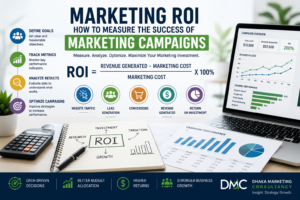
A common formula used to calculate Marketing ROI is :
Marketing ROI = ((Revenue Generated – Marketing Cost) ÷ Marketing Cost) × 100
Example
Suppose a company spends BDT 100,000 on a marketing campaign and generates BDT 300,000 in revenue.
Marketing ROI:
((300,000 – 100,000) ÷ 100,000) × 100
= 200%
This means the business earned a 200% return on its marketing investment.
Key Metrics for Measuring Marketing Success
While revenue is important, successful marketing campaigns should be evaluated using multiple performance indicators.
Website Traffic
Website traffic measures the number of visitors arriving at a website through various marketing channels.
Important indicators include:
- Total visitors
- Organic traffic
- Referral traffic
- Direct traffic
- Page views
Lead Generation
Leads represent potential customers interested in products or services.
Key lead generation metrics include:
- Number of leads
- Cost per lead
- Lead quality
- Lead conversion rate
Conversion Rate
Conversion rate measures the percentage of visitors who complete desired actions such as:
- Filling out forms
- Requesting consultations
- Purchasing products
- Subscribing to newsletters
Customer Acquisition Cost (CAC)
Customer Acquisition Cost measures how much it costs to acquire a new customer.
Lower acquisition costs generally indicate more efficient marketing efforts.
Customer Lifetime Value (CLV)
Customer Lifetime Value estimates the total revenue generated from a customer throughout their relationship with a business.
Businesses should aim to maximize CLV while controlling acquisition costs.
Social Media Engagement
Social media performance can be evaluated through:
- Likes
- Shares
- Comments
- Reach
- Engagement rates
These indicators help businesses understand audience interaction and brand awareness.
Measuring ROI Across Different Marketing Channels :
Search Engine Optimization (SEO)
SEO success can be measured using:
- Organic traffic growth
- Keyword rankings
- Lead generation
- Conversion rates
SEO often provides long-term returns and sustainable growth.
Google Ads
Google Ads ROI can be measured through:
- Cost per click
- Conversion rate
- Cost per acquisition
- Revenue generated
Social Media Marketing
Social media ROI can be evaluated through:
- Engagement
- Website visits
- Leads generated
- Customer inquiries
Email Marketing
Important email marketing metrics include:
- Open rates
- Click-through rates
- Conversion rates
- Revenue generated
Email marketing often produces one of the highest returns among digital marketing channels.
Common Challenges in Measuring Marketing ROI
Multiple Customer Touchpoints
Customers often interact with several marketing channels before making purchasing decisions.
Long Sales Cycles
Some industries require weeks or months before leads convert into customers.
Attribution Issues
Determining which marketing activity deserves credit for a conversion can be challenging.
Data Quality Problems
Incomplete or inaccurate data can lead to incorrect ROI calculations.
Best Practices for Improving Marketing ROI
Define Clear Objectives
Every marketing campaign should have specific and measurable goals.
Track Relevant Metrics
Focus on metrics directly connected to business objectives.
Use Analytics Tools
Tools such as Google Analytics, Google Search Console, CRM systems, and marketing dashboards help improve measurement accuracy.
Test and Optimize Campaigns
Regular testing helps identify high-performing strategies.
Invest in Customer Retention
Retaining existing customers often generates higher ROI than acquiring new customers.
Align Marketing and Sales Teams
Collaboration between marketing and sales departments improves lead quality and conversion performance.
The Role of Marketing Consultancy in ROI Improvement :
Many businesses struggle to accurately measure marketing performance. Professional marketing consultancy services can help organizations:
- Develop measurement frameworks
- Conduct marketing audits
- Improve campaign effectiveness
- Optimize budgets
- Increase conversion rates
- Enhance customer acquisition strategies
At Dhaka Marketing Consultancy (DMC), businesses can receive strategic support in marketing planning, market research, customer insights, performance measurement and digital marketing optimization to maximize Marketing ROI and long-term growth.
Conclusion :
Marketing ROI is one of the most important indicators of marketing success. Businesses that consistently measure and analyze ROI can make better decisions, allocate resources efficiently and improve overall performance.
Rather than relying on assumptions, organizations should adopt data-driven approaches to evaluate marketing effectiveness. By monitoring key metrics, optimizing campaigns and continuously improving strategies, businesses can achieve higher returns and sustainable growth.
In today’s competitive marketplace, measuring Marketing ROI is no longer optional—it is essential for long-term business success.