Introduction
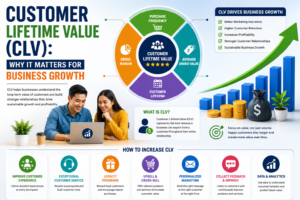
In today’s competitive business environment, acquiring new customers is important but retaining existing customers is often even more valuable. Many businesses focus heavily on attracting new customers while overlooking the long-term value that loyal customers bring to the organization. This is where Customer Lifetime Value (CLV) becomes a critical marketing and business metric.
Customer Lifetime Value measures the total revenue a business can expect to earn from a customer throughout their relationship with the company. Rather than evaluating customers based on a single purchase, CLV helps organizations understand the long-term financial contribution of each customer.
Businesses that focus on increasing Customer Lifetime Value often achieve stronger profitability, improved customer retention, better marketing performance and sustainable growth. Understanding CLV enables companies to make smarter decisions regarding customer acquisition, marketing investments, customer service and relationship management.
This article explores the concept of Customer Lifetime Value, its importance, calculation methods, benefits, challenges and strategies businesses can use to maximize customer value and drive long-term business growth.
What is Customer Lifetime Value (CLV)?
Customer Lifetime Value (CLV), sometimes referred to as Customer Lifetime Revenue or Lifetime Customer Value, represents the total amount of revenue a customer generates for a business during the entire period of their relationship.
Rather than focusing on a single transaction, CLV considers:
- Purchase frequency
- Average order value
- Customer retention duration
- Long-term customer behavior
In simple terms, CLV answers an important business question:
“How much is a customer worth to our business over time?”
Understanding this value helps businesses prioritize long-term customer relationships rather than short-term sales.
Why Customer Lifetime Value Matters
Many businesses focus exclusively on customer acquisition. While acquiring new customers is important, retaining existing customers is often more cost-effective and profitable.
Customer Lifetime Value helps businesses:
- Measure customer profitability
- Improve marketing efficiency
- Increase customer retention
- Optimize customer acquisition costs
- Strengthen customer relationships
- Support long-term business planning
Organizations that understand customer value can allocate resources more effectively and maximize returns on marketing investments.
Understanding the Relationship Between CLV and Business Growth
Business growth depends on generating sustainable revenue and maintaining profitable customer relationships.
CLV contributes to growth by helping businesses:
Identify Valuable Customers
Not all customers contribute equally to revenue.
CLV helps businesses identify high-value customers who deserve additional attention and personalized experiences.
Improve Customer Retention
Retaining customers often costs less than acquiring new ones.
Higher retention rates typically increase overall customer lifetime value.
Increase Profitability
Long-term customers often purchase more frequently and require less marketing expenditure.
Enhance Marketing ROI
Businesses can allocate marketing budgets more effectively when they understand customer value.
How to Calculate Customer Lifetime Value
There are several methods for calculating CLV.
A simplified formula is:
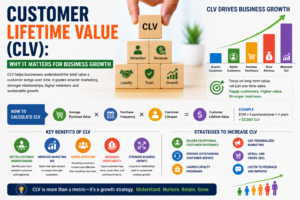
CLV = Average Purchase Value × Purchase Frequency × Customer Lifespan
Example
Suppose a customer:
- Spends $100 per purchase
- Makes 5 purchases per year
- Remains a customer for 4 years
Calculation:
CLV = $100 × 5 × 4
CLV = $2,000
This means the customer is expected to generate approximately $2,000 in revenue during their relationship with the business.
While more advanced calculations may include profit margins, acquisition costs, and discount rates, the basic formula provides a useful starting point.
Key Components of Customer Lifetime Value
Average Purchase Value
This measures the average amount spent during each transaction.
Businesses can increase purchase value through:
- Up-selling
- Cross-selling
- Premium offerings
- Bundled products
Purchase Frequency
Purchase frequency reflects how often customers buy.
Higher purchase frequency generally leads to higher CLV.
Customer Lifespan
Customer lifespan represents the length of time customers remain active.
Longer customer relationships significantly increase lifetime value.
Benefits of Measuring Customer Lifetime Value
Better Customer Understanding
CLV helps businesses understand which customer segments contribute most to revenue.
This knowledge supports more effective targeting and relationship management.
Improved Marketing Decisions
Businesses can determine how much they can afford to spend acquiring customers.
For example:
If a customer’s CLV is $2,000, spending $200 to acquire that customer may be reasonable.
Without CLV data, marketing spending decisions become less accurate.
Increased Customer Retention
Understanding customer value encourages businesses to invest in retention strategies.
Examples include:
- Loyalty programs
- Personalized communication
- Customer support improvements
- Exclusive offers
Retention often generates greater returns than acquisition alone.
More Effective Resource Allocation
Businesses can focus resources on customer segments that generate the highest value.
This improves operational efficiency and profitability.
Long-Term Strategic Planning
CLV provides valuable insights for forecasting future revenue and planning business growth initiatives.
Organizations can make more informed decisions regarding expansion, investment and customer relationship strategies.
Customer Lifetime Value and Marketing Strategy
CLV plays a crucial role in modern marketing strategy.
Customer Segmentation
Businesses can segment customers based on value levels.
Examples:
- High-value customers
- Medium-value customers
- Low-value customers
Each segment may require different marketing approaches.
Personalized Marketing
High-value customers often benefit from personalized experiences.
Examples include:
- Customized offers
- Exclusive promotions
- Priority support
- Tailored recommendations
Personalization strengthens customer relationships and increases retention.
Marketing Budget Optimization
CLV helps marketers determine:
- Customer acquisition budgets
- Advertising investments
- Retention spending
Organizations can focus investments where they generate the greatest returns.
Strategies to Increase Customer Lifetime Value
1. Improve Customer Experience
Customer experience significantly influences retention and loyalty.
Businesses should focus on:
- Easy purchasing processes
- Fast customer support
- Consistent communication
- Reliable service delivery
Satisfied customers are more likely to remain loyal.
2. Enhance Customer Service
Excellent customer service builds trust and encourages repeat business.
Effective customer service includes:
- Quick response times
- Problem resolution
- Friendly communication
- Proactive support
Positive experiences often increase customer lifetime value.
3. Implement Loyalty Programs
Loyalty programs reward customers for continued engagement.
Examples include:
- Points systems
- Membership benefits
- Exclusive discounts
- Reward programs
These initiatives encourage repeat purchases.
4. Use Personalized Communication
Customers appreciate relevant and personalized interactions.
Businesses can personalize:
- Email campaigns
- Product recommendations
- Promotional offers
- Customer support
Personalization strengthens customer relationships.
5. Up-selling and Cross-Selling
Businesses can increase customer value by offering complementary products or upgraded solutions.
Examples:
- Premium product versions
- Additional services
- Product bundles
These strategies increase average purchase value.
6. Collect and Act on Customer Feedback
Customer feedback helps businesses improve products, services, and experiences.
Methods include:
- Surveys
- Reviews
- Interviews
- Customer satisfaction studies
Listening to customers often improves retention and loyalty.
Common Challenges in Managing CLV
Data Collection Difficulties
Accurate CLV calculations require reliable customer data.
Businesses should invest in proper data management systems.
Changing Customer Behavior
Customer preferences evolve over time.
Regular analysis is necessary to maintain accurate customer value estimates.
Market Competition
Competitors may attempt to attract valuable customers.
Strong customer relationships help reduce this risk.
Short-Term Focus
Some businesses prioritize immediate sales over long-term customer value.
Sustainable growth requires balancing both objectives.
Technology and Customer Lifetime Value
Modern technologies make CLV analysis more effective.
Customer Relationship Management (CRM) Systems
CRM platforms help track customer interactions and purchasing behavior.
Marketing Automation
Automation supports personalized communication and customer engagement.
Artificial Intelligence (AI)
AI helps predict customer behavior and identify opportunities to increase lifetime value.
Data Analytics
Advanced analytics provide deeper insights into customer trends and profitability.
Technology enables businesses to manage customer relationships more strategically.
Customer Lifetime Value and Sustainable Business Growth
Sustainable growth depends on building long-term customer relationships rather than relying solely on continuous customer acquisition.
Businesses that prioritize CLV often experience:
- Higher profitability
- Improved customer loyalty
- Stronger brand reputation
- Better marketing performance
- Increased revenue stability
Long-term customer relationships create a foundation for sustainable success.
Best Practices for Maximizing Customer Lifetime Value
Businesses should:
- Focus on customer satisfaction
- Deliver consistent value
- Invest in customer retention
- Use personalized marketing
- Monitor customer behavior
- Continuously improve customer experiences
- Measure and analyze CLV regularly
These practices help maximize customer profitability and strengthen business performance.
Conclusion
Customer Lifetime Value (CLV) is one of the most important metrics for understanding customer profitability and supporting long-term business growth. Rather than focusing solely on individual transactions, CLV encourages businesses to view customers as long-term assets that contribute ongoing value.
By measuring and increasing Customer Lifetime Value, organizations can improve marketing efficiency, strengthen customer relationships, increase profitability, and achieve sustainable growth. Businesses that prioritize customer retention, personalization, customer satisfaction and continuous improvement are more likely to maximize lifetime value and outperform competitors.
In today’s customer- centrist marketplace, understanding Customer Lifetime Value is no longer optional—it is essential for building lasting customer relationships and creating a strong foundation for future business success.