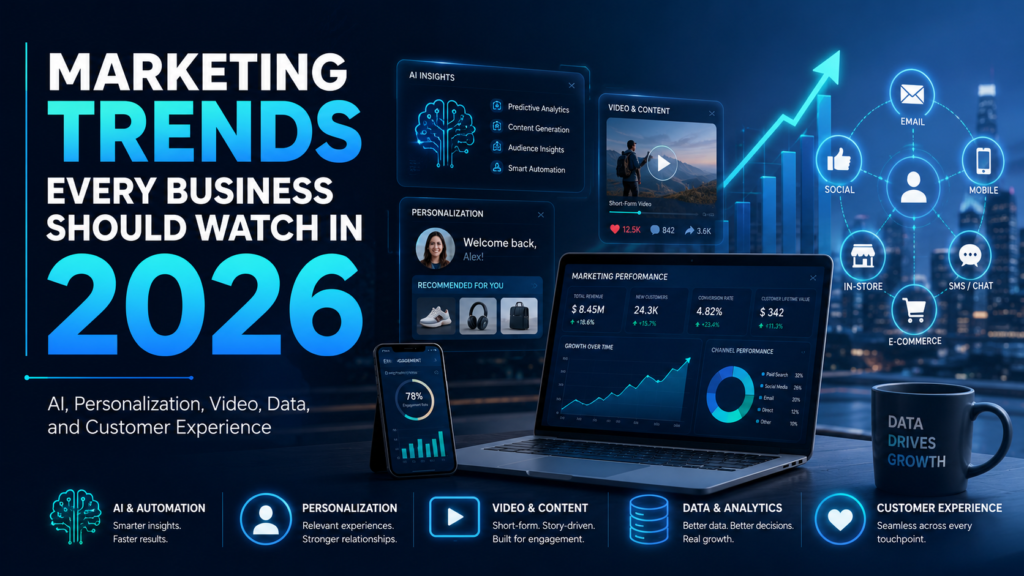
Marketing is changing faster than ever. Customers are using more digital platforms, comparing brands more carefully, expecting faster responses and demanding more personalized experiences. In 2026, businesses can no longer depend only on traditional advertising or random social media posting. They need smarter, data-driven, customer-focused and technology-supported marketing strategies.
For modern businesses, especially small and medium enterprises, understanding the latest marketing trends is not just an option; it is a necessity. A business that understands customer behavior, uses the right digital channels, builds trust and adapts to new technologies can achieve stronger brand visibility, better lead generation and sustainable growth.
Here are the most important marketing trends every business should watch in 2026.
1. AI-Powered Marketing Will Become More Practical
Artificial intelligence is no longer only for large corporations. In 2026, AI-powered marketing tools are becoming more practical and accessible for businesses of different sizes. Businesses can use AI for content ideas, customer support, email writing, campaign planning, audience analysis, competitor research and performance reporting.
AI can help marketers save time and make better decisions. For example, a business can use AI to analyze customer questions, identify common problems, prepare quick replies, and create personalized marketing messages. AI can also support advertising by helping businesses understand which audience groups are more likely to respond.
However, businesses should not depend on AI blindly. Human judgment is still necessary for strategy, brand voice, creativity, ethics, and customer understanding. The best approach is to use AI as a support tool, not as a complete replacement for marketing expertise.
2. AI Search and Answer Engine Optimization Will Matter
Search marketing is changing. Customers are not only using traditional Google search results; they are also receiving AI-generated summaries, recommendations, and direct answers. Google has been moving Search toward AI-powered experiences, including AI Mode and AI Overviews. This means businesses need to think beyond traditional SEO.
In 2026, businesses should focus on creating clear, helpful, trustworthy, and well-structured content. Articles should answer real customer questions, include practical examples and explain topics in a simple way. Businesses also need consistent brand information across websites, blogs, social media, YouTube, Google Business Profile and other platforms.
AI search systems often depend on clear and reliable information. If a brand has confusing, incomplete, or inconsistent information online, it may lose visibility. Therefore, businesses should improve both SEO and answer engine optimization by publishing useful content and maintaining a strong digital identity.
3. First-Party Data Will Become More Valuable
Businesses are realizing that customer data is one of their most important assets. First-party data means information collected directly from customers through website forms, email subscriptions, purchase history, customer inquiries, CRM systems, surveys and loyalty programs.
In 2026, businesses should focus on building their own customer database. Depending only on social media platforms is risky because algorithm changes can reduce visibility at any time. A business should collect customer information ethically and use it to improve communication, offers and service quality.
For example, a marketing consultancy can keep records of client industry, business problems, inquiry date, preferred service and follow-up status. This helps the business provide more relevant communication and convert leads more effectively.
4. Personalization Will Influence Customer Decisions
Modern customers do not want generic messages. They prefer communication that matches their needs, interests, location and buying stage. Personalization is one of the strongest marketing trends in 2026.
Personalization can be simple or advanced. A small business can personalize messages by addressing customer needs directly. A larger business can use CRM and automation tools to send different messages to different customer groups.
For example, a restaurant owner may need local customer acquisition support, while a real estate company may need lead generation and brand positioning. Sending the same marketing message to both may not be effective. Personalized communication improves trust, engagement and conversion.
5. Omnichannel Customer Experience Will Be Essential
Customers now move across many channels before making a decision. They may see a Facebook post, visit a website, check Google reviews, send a WhatsApp message, and then call the business. If these channels are not connected, the customer experience becomes weak.
In 2026, omnichannel marketing will become more important. Businesses should connect websites, social media, WhatsApp, email, Google Business Profile, physical office and customer support into one smooth system.
The message, offer, brand tone and service information should remain consistent everywhere. A customer should not receive one price on Facebook and another on WhatsApp. They should not find one service description on the website and a different explanation from the sales team. Consistency builds trust.
6. Short-Form Video Will Continue to Grow
Short-form video content will remain one of the most powerful marketing tools in 2026. Platforms like Facebook Reels, Instagram Reels, TikTok, YouTube Shorts and LinkedIn video can help businesses reach customers quickly.
Short videos are effective because they are easy to consume, shareable, and engaging. A business can use short videos to explain services, show customer problems, present solutions, share tips, introduce team members, highlight success stories and promote offers.
However, video content should not be random. It should have a clear message, strong hook, simple language, good visuals and a call-to-action. A 15-second video with a clear business message can sometimes perform better than a long and unclear advertisement.
7. Trust-Based Marketing Will Become Stronger
Customers are becoming more careful before buying. They compare options, read reviews, check websites and look for credibility. In 2026, trust will be one of the strongest factors in marketing success.
Businesses should build trust through professional websites, clear service descriptions, authentic content, customer testimonials, case studies, transparent communication and consistent branding. For service-based businesses, trust is even more important because customers often pay before seeing the final result.
A business that communicates honestly and professionally can stand out from competitors. Trust-based marketing does not always require a large budget. It requires consistency, quality and customer care.
8. Social Commerce and Direct Messaging Will Increase
Social media platforms are becoming more connected with shopping, inquiry, booking and customer support. Customers often prefer sending a direct message instead of filling out a long form. WhatsApp, Messenger, Instagram DM and Facebook inbox are becoming important lead generation tools.
Meta has also been expanding AI-powered business support through WhatsApp Business and other messaging platforms, showing how customer communication is becoming more automated and conversational.
In 2026, businesses should improve their direct messaging strategy. Quick replies, greeting messages, product/service menus, follow-up messages and professional response templates can improve customer experience and increase conversion rates.
9. Content Quality Will Matter More Than Quantity
Many businesses post content regularly but do not get results because the content is not useful. In 2026, quality content will matter more than posting frequency.
Google and AI-powered search systems reward content that is helpful, clear, original, and relevant. Businesses should focus on solving customer problems through blog posts, guides, FAQs, videos, info-graphics and case studies.
A strong content strategy should answer questions such as: What problem does the customer face? What solution does the business offer? Why should the customer trust this business? What action should the customer take next?
Quality content can generate organic traffic, educate customers, improve brand authority and support sales.
10. Marketing Automation Will Save Time and Improve Follow-Up
Many businesses lose leads because they fail to follow up properly. In 2026, marketing automation will become more useful for lead nurturing, email campaigns, customer reminders, CRM updates and sales communication.
Automation does not mean removing human communication. It means supporting the business process so that no important lead is missed. For example, when a customer fills out a form, the business can automatically send a thank-you message and then follow up later with service details.
Hub-spot and Salesforce are both positioning their platforms around connected CRM, AI, customer data, and automation, which shows how important integrated marketing systems have become.
Conclusion
Marketing in 2026 will be more intelligent, more connected, and more customer-focused. Businesses that want to grow must understand the importance of AI, SEO, first-party data, personalization, omnichannel communication, short-form video, trust-building, social commerce, quality content and automation.
The goal is not to follow every trend blindly. The goal is to choose the right trends that match the business, target audience, budget and growth objectives. A small business can start with a professional website, useful content, WhatsApp communication, customer data collection and consistent social media activity. A larger business can add CRM, automation, advanced analytics and AI-powered personalization.
In 2026, successful marketing will depend on one major principle: understand the customer better and serve them more effectively across every channel. Businesses that follow this principle will be more prepared for competition, customer expectations and long-term growth.