Introduction
In today’s highly competitive business environment, launching a new product without understanding market needs can be risky and costly. Many products fail not because they lack quality but because they do not meet customer expectations, solve meaningful problems or fit market demand. This is where marketing research plays a critical role.
Marketing research provides businesses with valuable insights into customer needs, market trends, competitor activities and potential opportunities. By gathering and analyzing relevant information before, during, and after product development, organizations can make informed decisions that increase the likelihood of success.
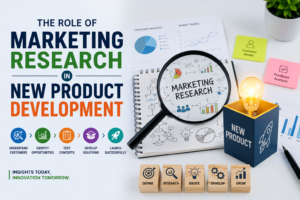
New product development (NPD) is a strategic process that involves generating ideas, evaluating opportunities, designing products, testing concepts and introducing products to the market. Marketing research supports each stage of this process by reducing uncertainty and helping businesses create products that customers truly value.
This article explores the importance of marketing research in new product development, the various research methods used, and how businesses can leverage research to improve product success and achieve sustainable growth.
Understanding Marketing Research
Marketing research is the systematic process of collecting, analyzing, and interpreting information related to customers, markets, competitors and business environments.
The primary objectives of marketing research include:
- Understanding customer needs
- Identifying market opportunities
- Evaluating customer preferences
- Assessing competition
- Supporting strategic decision-making
- Reducing business risks
Effective marketing research transforms raw data into actionable insights that guide business decisions.
Understanding New Product Development
New Product Development (NPD) refers to the process of creating and introducing new products or services to the market.
The typical stages of NPD include:
- Idea Generation
- Idea Screening
- Concept Development
- Market Research
- Product Design and Development
- Product Testing
- Commercialization
- Post-Launch Evaluation
Marketing research contributes significantly throughout each of these stages.
Why Marketing Research is Essential in New Product Development
Reduces Business Risk
One of the greatest benefits of marketing research is risk reduction.
Before investing substantial resources in product development, businesses can evaluate whether genuine market demand exists.
Research helps answer critical questions:
- Do customers need this product?
- Will customers pay for it?
- Who are the target customers?
- What features are most important?
By identifying potential challenges early, organizations can avoid costly mistakes.
Improves Customer Understanding
Successful products are built around customer needs.
Marketing research helps businesses understand:
- Customer problems
- Preferences
- Buying behavior
- Expectations
- Satisfaction drivers
The better a company understands its customers, the more likely it is to develop products that meet market demand.
Identifies Market Opportunities
Research helps businesses discover unmet needs and emerging trends.
Opportunities may include:
- Under-served customer segments
- New market niches
- Changing consumer behavior
- Technological advancements
- Industry gaps
Organizations that identify opportunities early often gain competitive advantages.

The Role of Marketing Research in Each Stage of Product Development
1. Idea Generation
Every successful product begins with an idea.
Marketing research helps generate ideas by identifying:
- Customer frustrations
- Market trends
- Competitor weaknesses
- Emerging technologies
Research sources may include:
- Customer feedback
- Social media discussions
- Industry reports
- Market surveys
These insights inspire innovative product concepts.
2. Idea Screening
Not every idea deserves further investment.
Marketing research helps evaluate whether a concept has market potential.
Businesses can assess:
- Market size
- Customer interest
- Competitive intensity
- Profitability potential
Screening reduces the likelihood of pursuing weak ideas.
3. Concept Development and Testing
Before developing a product, businesses often test concepts with potential customers.
Concept testing helps answer:
- Is the idea appealing?
- Does it solve a real problem?
- What improvements are needed?
- How likely are customers to purchase it?
Customer feedback during this stage can significantly improve product design.
4. Product Design and Development
Marketing research provides guidance for product features and specifications.
Businesses can determine:
- Preferred features
- Design preferences
- Packaging requirements
- Pricing expectations
Rather than relying on assumptions, companies can use customer insights to build products that align with market demand.
5. Product Testing
Product testing allows businesses to evaluate performance before launch.
Research methods include:
- Prototype testing
- User testing
- Pilot launches
- Focus groups
Testing helps identify issues and opportunities for improvement.
Benefits include:
- Better product quality
- Increased customer satisfaction
- Reduced launch risk
6. Market Launch Planning
Marketing research helps businesses develop effective launch strategies.
Research supports decisions related to:
- Pricing
- Distribution
- Promotion
- Target audience selection
- Positioning
A strong launch strategy increases product visibility and adoption.
7. Post-Launch Evaluation
Research remains important after the product enters the market.
Businesses should monitor:
- Customer satisfaction
- Sales performance
- Customer reviews
- Competitive responses
- Market acceptance
Continuous feedback supports ongoing improvement and long-term success.
Types of Marketing Research Used in Product Development
Primary Research
Primary research involves collecting original data directly from customers.
Methods include:
Surveys
Businesses gather opinions from large groups of customers.
Interviews
One-on-one discussions provide deeper insights.
Focus Groups
Small group discussions explore customer attitudes and perceptions.
Observation
Businesses observe customer behavior in real-world environments.
Primary research offers highly relevant and customized information.
Secondary Research
Secondary research uses existing information from external sources.
Examples include:
- Industry reports
- Government statistics
- Academic publications
- Competitor analyses
- Market databases
Secondary research is often cost-effective and useful for understanding broader market conditions.
Key Research Questions for New Product Development
Businesses should seek answers to several critical questions:
Customer Questions
- Who are the target customers?
- What problems do they face?
- What solutions are they seeking?
Market Questions
- How large is the market?
- Is demand increasing or decreasing?
- What trends are emerging?
Competitive Questions
- Who are the competitors?
- What products already exist?
- How can differentiation be achieved?
Financial Questions
- What price will customers accept?
- What sales volume is required for profitability?
Answering these questions improves product development decisions.
Benefits of Marketing Research in New Product Development
Better Product-Market Fit
Research helps align products with customer needs.
Increased Success Rates
Products developed through research are more likely to succeed.
Improved Customer Satisfaction
Products that address customer needs often generate higher satisfaction.
More Effective Marketing Strategies
Research supports better targeting, positioning, and communication.
Reduced Development Costs
Early identification of issues prevents costly redesigns and failed launches.
Stronger Competitive Advantage
Businesses can identify opportunities that competitors may overlook.
Common Mistakes to Avoid
Skipping Research
Some businesses rely on assumptions instead of data.
Researching Too Late
Research should begin early and continue throughout development.
Ignoring Customer Feedback
Customer insights should influence product decisions.
Using Insufficient Samples
Small or biased samples may produce misleading results.
Focusing Only on Existing Customers
Potential customers may have different needs and expectations.
Avoiding these mistakes improves research quality and decision-making.
How Technology is Transforming Marketing Research
Modern technologies are making research faster and more accurate.
Artificial Intelligence (AI)
AI helps analyze large datasets and identify patterns.
Online Surveys
Digital platforms make data collection more efficient.
Social Media Analytics
Businesses can monitor customer conversations and market trends.
Big Data Analytics
Large-scale data analysis provides deeper market insights.
Technology enables businesses to make more informed product development decisions.
Marketing Research and Sustainable Business Growth
Successful product development contributes directly to business growth.
Marketing research supports sustainable growth by:
- Reducing uncertainty
- Improving innovation
- Increasing customer satisfaction
- Enhancing profitability
- Strengthening market competitiveness
Organizations that consistently use research are better positioned to adapt to changing customer needs and market conditions.
Conclusion
Marketing research is one of the most important components of successful new product development. It helps businesses understand customers, identify opportunities, evaluate ideas, improve product design and reduce risks throughout the development process.
In today’s rapidly changing marketplace, relying on assumptions is no longer sufficient. Businesses that invest in research-driven decision-making are more likely to create products that customers value and adopt.
From idea generation to post-launch evaluation, marketing research provides the insights necessary to improve product success, enhance customer satisfaction and support sustainable business growth.
Organizations that make marketing research a core part of their product development strategy gain a significant competitive advantage and increase their chances of long-term success in increasingly competitive markets.