
Introduction
In today’s highly competitive marketplace, businesses must do more than simply offer products or services. Customers are constantly presented with numerous alternatives, making it increasingly difficult for organizations to capture attention and earn loyalty. To stand out from competitors and attract the right customers, businesses need a strong value proposition.
A value proposition is one of the most important elements of a successful marketing strategy. It clearly communicates why customers should choose a particular business over competitors. A compelling value proposition highlights the unique benefits, solutions and value that customers can expect to receive.
Whether a company is a startup, a small business or a large corporation, a strong value proposition serves as the foundation for marketing, branding, customer acquisition and business growth. Organizations that effectively communicate their value are more likely to attract customers, increase conversions and build long-term relationships.
This article explores what a value proposition is, why it matters and how businesses can develop a powerful value proposition that drives sustainable growth.
What is a Value Proposition?
A value proposition is a clear statement that explains the benefits a customer receives from a product, service, or business.
It answers three essential questions:
- What problem does the business solve?
- What benefits does it provide?
- Why should customers choose it instead of competitors?
A strong value proposition focuses on customer needs rather than simply describing products or services.
Example
Instead of saying:
“We provide digital marketing services.”
A stronger value proposition would be:
“We help small businesses generate more qualified leads and increase sales through data-driven digital marketing strategies.”
The second statement focuses on customer outcomes and business value.
Why a Strong Value Proposition Matters
Attracts the Right Customers
Customers are more likely to engage with businesses that clearly communicate relevant benefits.
Differentiates from Competitors
A value proposition highlights unique advantages that competitors may not offer.
Improves Marketing Effectiveness
Marketing campaigns become more focused and persuasive when built around a clear value proposition.
Increases Conversion Rates
Customers are more likely to take action when they understand the value they will receive.
Supports Brand Positioning
A strong value proposition helps establish a distinct and memorable market position.
Key Elements of a Strong Value Proposition
Clear Customer Focus
The value proposition should focus on customer needs rather than company achievements.
Customers care about:
- Solving problems
- Saving time
- Reducing costs
- Improving outcomes
Businesses should communicate how they help customers achieve these goals.
Specific Benefits
Avoid vague claims such as:
- High quality
- Excellent service
- Professional solutions
Instead, provide specific benefits.
Examples:
- Increase sales performance
- Improve customer retention
- Reduce operational costs
- Generate more qualified leads
Specific benefits create stronger customer interest.
Differentiation
A strong value proposition explains why a business is different.
Differentiation may come from:
- Expertise
- Innovation
- Customer service
- Technology
- Pricing strategy
- Industry specialization
Customers need a clear reason to choose one business over another.
Credibility
Value propositions should be realistic and supported by evidence.
Businesses can strengthen credibility through:
- Case studies
- Customer testimonials
- Research findings
- Performance data
- Industry experience
Trust plays a significant role in customer decision-making.
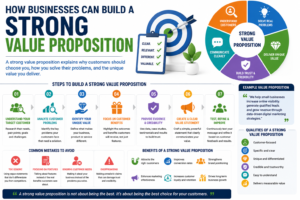
Steps to Build a Strong Value Proposition
Step 1: Understand Your Target Market
The foundation of every strong value proposition is customer understanding.
Businesses should identify:
- Customer needs
- Pain points
- Goals
- Challenges
- Preferences
Market research can provide valuable insights into customer expectations.
Step 2: Analyze Customer Problems
Successful businesses solve meaningful problems.
Ask questions such as:
- What frustrates customers?
- What obstacles do they face?
- What outcomes do they desire?
The better a business understands customer challenges, the stronger its value proposition can become.
Step 3: Identify Business Strengths
Businesses should evaluate their unique capabilities.
Examples include:
- Specialized expertise
- Industry knowledge
- Faster service delivery
- Better customer support
- Innovative solutions
These strengths become the foundation of differentiation.
Step 4: Study Competitors
Competitor analysis helps businesses identify market gaps.
Evaluate:
- Competitor offerings
- Pricing strategies
- Customer reviews
- Marketing messages
Understanding competitors helps businesses position themselves more effectively.
Step 5: Define Customer Benefits
Focus on outcomes rather than features.
Feature:
“Marketing research service.”
Benefit:
“Provides data-driven insights that reduce business risk and support better decision-making.”
Customers typically respond more positively to benefits than features.
Step 6: Create a Clear Value Statement
A simple formula is:
We help [target customers] achieve [desired outcome] through [unique solution].
Example:
“We help growing businesses identify market opportunities and improve marketing performance through professional research and strategic consulting.”
This format clearly communicates value.
Common Mistakes to Avoid
Being Too Generic
Statements such as:
“We provide quality services.”
offer little differentiation.
Customers need specific reasons to choose a business.
Focusing on Features Only
Features are important, but customers primarily care about benefits and outcomes.
Ignoring Customer Needs
Businesses sometimes focus too much on their own capabilities rather than customer challenges.
Effective value propositions prioritize customer value.
Over-promising
Exaggerated claims can damage credibility.
Value propositions should be realistic and achievable.
Examples of Strong Value Propositions
Technology Company
“Helping businesses automate repetitive tasks and improve productivity through intelligent software solutions.”
E-Commerce Business
“Delivering high-quality products at affordable prices with fast and reliable shipping.”
Marketing Consultancy
“Helping businesses make smarter marketing decisions through market research, customer insights, and strategic planning.”
Each example clearly communicates customer benefits and unique value.
How Value Propositions Support Marketing Success
A strong value proposition strengthens multiple areas of marketing.
Content Marketing
Content becomes more focused on customer needs and solutions.
Advertising
Advertising messages become more persuasive and relevant.
Sales Conversations
Sales teams can communicate benefits more effectively.
Customer Retention
Customers are more likely to remain loyal when they consistently receive promised value.
Measuring the Effectiveness of a Value Proposition
Businesses should regularly evaluate whether their value proposition resonates with customers.
Key indicators include:
- Conversion rates
- Customer acquisition
- Customer retention
- Customer satisfaction
- Lead generation performance
- Revenue growth
Customer feedback can also provide valuable insights.
The Role of Market Research in Developing a Value Proposition
Market research helps businesses understand:
- Customer needs
- Market trends
- Competitor positioning
- Industry opportunities
Research reduces guesswork and improves strategic decision-making.
Businesses that rely on research often develop stronger and more relevant value propositions.
Value Proposition and Long-Term Business Growth
A strong value proposition contributes directly to sustainable growth.
Benefits include:
- Stronger customer relationships
- Increased customer loyalty
- Higher marketing effectiveness
- Improved competitive positioning
- Better business performance
Organizations that consistently deliver value are more likely to achieve long-term success.
Conclusion
A strong value proposition is one of the most powerful tools a business can use to attract customers, differentiate itself from competitors and drive growth. It clearly communicates the benefits customers receive and explains why a business is the best choice for solving their problems.
Developing an effective value proposition requires understanding customer needs, analyzing competitors, identifying strengths and focusing on meaningful customer outcomes. Businesses that invest time in creating and refining their value proposition often experience stronger marketing performance, improved customer loyalty and sustainable business growth.
In an increasingly competitive marketplace, organizations that clearly communicate their value are better positioned to earn customer trust, build lasting relationships and achieve long-term success.