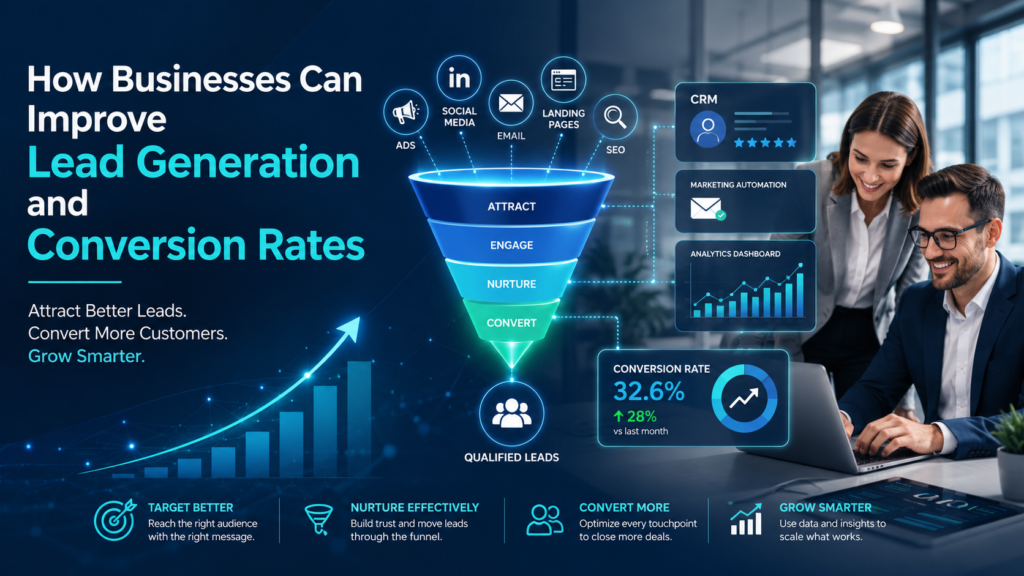
Every business needs customers, but customers do not usually come automatically. A business must attract the right people, communicate the right message, build trust and guide potential customers toward a buying decision. This process is known as lead generation and conversion. In modern marketing, these two activities are extremely important for sustainable business growth.
Lead generation means attracting potential customers who may be interested in a product or service. Conversion means turning those potential customers into actual buyers, clients, subscribers or qualified inquiries. A business may receive many website visitors, Facebook messages or phone calls, but if those people do not take action, the marketing effort may not produce real business results.
To grow successfully, businesses must focus not only on getting more leads but also on improving the quality of leads and increasing the conversion rate. A strong marketing strategy should connect awareness, interest, trust, communication and sales into one effective system.
What Is Lead Generation?
Lead generation is the process of identifying and attracting people who may become future customers. A lead can come from many sources, such as a website form, Facebook page, Google search, WhatsApp inquiry, email subscription, phone call, referral, event, advertisement or social media campaign.
For example, if a restaurant owner contacts a marketing consultancy after reading a blog post, that person is a lead. If a customer fills out a form to get a quotation for a service, that is also a lead. If someone messages a business page asking about price, location or service details, that person can be considered a potential lead.
However, all leads are not equal. Some leads are highly interested and ready to buy, while others are only collecting information. That is why businesses need to understand lead quality, not just lead quantity.
What Is Conversion Rate?
Conversion rate means the percentage of people who take a desired action after interacting with a business. This action may be purchasing a product, booking a consultation, submitting a form, calling the business, sending a WhatsApp message, downloading a brochure or subscribing to a newsletter.
For example, if 100 people visit a landing page and 10 people submit an inquiry form, the conversion rate is 10%. A higher conversion rate means the business is more effective at turning visitors or leads into real opportunities.
Improving conversion rate is often more profitable than only increasing traffic. A business may spend a lot of money to bring visitors to its website, but if the website is unclear, slow or untrustworthy, visitors may leave without taking action.
Why Lead Generation and Conversion Matter
Lead generation and conversion are important because they directly influence sales growth. A business cannot grow only by having a good product or service. It must also reach the right audience and convince them to take action.
Effective lead generation helps businesses create a steady flow of potential customers. Strong conversion strategy helps turn those leads into revenue. When both work together, the business can reduce marketing waste, improve return on investment and build long-term customer relationships.
For small and medium businesses, this is especially important because marketing budgets are often limited. Every campaign, post, advertisement and customer inquiry must be handled carefully.
1. Clearly Define the Target Audience
The first step to improving lead generation is understanding who the business wants to reach. Many businesses make the mistake of targeting everyone. But when marketing is too broad, the message becomes weak.
A business should identify its ideal customer based on age, location, income, profession, business type, interests, problems, needs and buying behavior. For B2B businesses, the target audience may include business owners, managers, directors, decision-makers or specific industry professionals.
When the target audience is clear, the business can create better content, better offers, better advertisements and better communication. This increases both lead quality and conversion rate.
2. Create a Strong Value Proposition
A value proposition explains why customers should choose one business over another. It should clearly answer three questions: what the business offers, what problem it solves and what benefit the customer will receive.
For example, a marketing consultancy should not only say, “We provide marketing services.” A stronger message would be: “We help businesses identify marketing problems, improve customer targeting, and create practical strategies for business growth.”
A strong value proposition makes the business easier to understand. It also helps customers quickly decide whether the service is relevant to them.
3. Build a Professional Website
A website is one of the most important tools for lead generation and conversion. Many customers search online before making a decision. If a business does not have a professional website, it may lose trust.
A good website should explain services clearly, show contact information, include strong call-to-action buttons, load quickly, work properly on mobile and present the business in a professional way.
Important pages may include Home, Services, About Us, Case Studies, Blog, Contact, Privacy Policy, and Terms & Conditions. For service-based businesses, adding a contact form, WhatsApp button, service details and client-focused content can improve lead generation.
The website should not only look attractive. It should guide visitors toward action.
4. Use Clear Call-to-Actions
A call-to-action or CTA, tells visitors what to do next. Without a clear CTA, customers may become interested but leave without contacting the business.
Examples of strong CTAs include:
“Request a Free Consultation”
“Get a Marketing Audit”
“Contact Us on WhatsApp”
“Book an Appointment”
“Ask for a Quotation”
“Start Your Business Growth Plan”
CTAs should be visible on important sections of the website, social media posts, ads, and landing pages. A good CTA reduces confusion and increases conversion.
5. Use Content Marketing to Build Trust
Content marketing is one of the most powerful ways to generate quality leads. When a business publishes helpful articles, guides, videos, case studies and social media posts, customers begin to trust the brand.
For example, a business consultancy can publish articles on marketing strategy, customer behavior, branding, market research, digital marketing, sales growth and business planning. These topics attract people who are already interested in business improvement.
Good content helps customers understand their problems and see the business as a trusted solution provider. Over time, this increases organic traffic, brand authority and lead generation.
6. Optimize for Search Engines
Search engine optimization or SEO, helps customers find a business through Google and other search engines. If a business website appears for relevant keywords, it can attract visitors without depending only on paid ads.
SEO includes keyword research, high-quality content, proper headings, meta title, meta description, internal links, image optimization, mobile performance and technical website improvements.
For lead generation, businesses should focus on keywords that match customer intent. For example, a company offering marketing consultancy may target keywords like “marketing strategy for business growth,” “market research services,” “digital marketing support,” or “business marketing audit.”
SEO takes time but it can generate long-term and trusted leads.
7. Improve Social Media Lead Generation
Social media platforms can be very useful for generating leads, especially when the content is relevant and consistent. Businesses should not post randomly. Each post should have a purpose, such as educating customers, showing expertise, building trust, promoting a service or encouraging inquiries.
Facebook, LinkedIn, Instagram, YouTube and TikTok can all be useful depending on the business type. For B2B services, LinkedIn and Facebook groups can be valuable. For visual products, Instagram and TikTok may work better.
The key is to connect social media with website, WhatsApp, phone and email so that interested people can easily contact the business.
8. Use Landing Pages for Specific Offers
A landing page is a focused page created for a specific campaign, service or offer. Instead of sending all visitors to the homepage, businesses can send them to a page designed for one clear action.
For example, a marketing consultancy may create a landing page for “Marketing Audit Service.” The page can explain the service, benefits, process, target clients and contact option. This focused experience usually converts better than a general page.
A good landing page should have a clear headline, customer problem, solution, benefits, proof, simple form and strong CTA.
9. Respond Quickly to Leads
Many businesses lose potential customers because they respond too late. In modern marketing, speed matters. If a customer sends a message and does not receive a quick response, they may contact a competitor.
Businesses should prepare quick replies, greeting messages, WhatsApp templates, email responses and basic service information. The response should be professional, helpful and clear.
Fast response builds trust and increases the chance of conversion. Even if the customer is not ready to buy immediately, proper follow-up can turn the lead into a future client.
10. Nurture Leads with Follow-Up
Not every lead will buy immediately. Some people need more time, more information or more trust. That is why lead nurturing is important.
Businesses can follow up through WhatsApp, email, phone or helpful content. The purpose is not to pressure the customer but to provide useful information and maintain communication.
For example, after an initial inquiry, a business can send a service summary, portfolio, case study, quotation or helpful article. This keeps the business in the customer’s mind and improves conversion chances.
11. Build Trust with Proof and Credibility
Customers are more likely to convert when they trust the business. Trust can be built through testimonials, case studies, reviews, client feedback, professional website design, clear service details, transparent communication and consistent branding.
If a business is new, it can still build credibility by showing expertise, publishing quality content, explaining the process clearly and maintaining professional communication.
Trust is one of the strongest factors in conversion. A customer may like a service but without trust, they may not take action.
12. Analyze Data and Improve Continuously
Lead generation and conversion should be measured regularly. Businesses should track website visitors, traffic sources, form submissions, WhatsApp clicks, phone calls, ad performance, social media engagement and sales results.
Tools like Google Analytics, Google Search Console, Meta Business Suite, Google Ads reports and CRM systems can help businesses understand what is working and what needs improvement.
If many people visit a page but do not contact the business, the CTA may need improvement. If ads generate leads but few sales, the targeting or follow-up process may need adjustment. If social media engagement is low, the content strategy may need improvement.
Marketing becomes stronger when decisions are based on data, not only guesswork.
Common Mistakes Businesses Should Avoid
Many businesses fail to generate quality leads because they do not have a clear strategy. Some depend only on paid ads without improving their website or follow-up process. Some collect leads but do not respond properly. Others attract the wrong audience because their message is unclear.
Another common mistake is focusing only on traffic. More traffic does not always mean more sales. Businesses need the right traffic, clear offers, strong trust signals and a smooth conversion process.
Businesses should also avoid using confusing service descriptions, weak visuals, slow websites, duplicate content and inconsistent branding.
Conclusion
Improving lead generation and conversion rates is one of the most important goals for modern businesses. It requires a clear target audience, strong value proposition, professional website, useful content, SEO, social media strategy, landing pages, fast response, lead nurturing, trust building and regular data analysis.
A successful business does not only collect leads. It understands customer needs, communicates value clearly and guides people toward confident decisions. When lead generation and conversion work together, businesses can reduce marketing waste, improve sales performance and achieve sustainable growth.
For modern businesses, the best approach is to build a complete marketing system where every channel supports the customer journey. This system helps attract the right people, convert them into customers and create long-term business success.