Introduction
In today’s competitive business environment, making decisions based on assumptions can lead to wasted resources and missed opportunities. Successful organizations rely on data-driven insights to evaluate performance, optimize marketing strategies and achieve sustainable growth. This is where marketing metrics play a critical role.
Marketing metrics provide measurable indicators that help businesses understand whether their marketing efforts are generating the desired results. By tracking the right metrics, organizations can identify strengths, uncover weaknesses, improve customer engagement and maximize return on investment (ROI).
Whether you operate a small business, startup, consultancy firm, or large corporation, understanding and monitoring key marketing metrics is essential for long-term success. This article explores the most important marketing metrics every business should track and explains how these metrics support effective decision-making and business growth.
What Are Marketing Metrics?
Marketing metrics are measurable values used to assess the performance and effectiveness of marketing activities.
They help businesses answer important questions such as:
- Are marketing campaigns generating results?
- Is website traffic increasing?
- Are leads converting into customers?
- Is customer engagement improving?
- Is marketing investment delivering positive returns?
Without proper measurement, businesses cannot accurately evaluate marketing success or identify areas for improvement.
Why Marketing Metrics Matter
Tracking marketing metrics offers numerous benefits:
Better Decision-Making
Reliable data helps businesses make informed strategic decisions rather than relying on guesswork.
Improved Marketing Performance
Metrics reveal what is working and what needs improvement, enabling continuous optimization.
Increased ROI
Monitoring performance helps organizations allocate resources more efficiently and maximize returns.
Stronger Customer Understanding
Metrics provide valuable insights into customer behavior, preferences, and purchasing patterns.
Sustainable Business Growth
Data-driven marketing strategies support long-term profitability and competitive advantage.
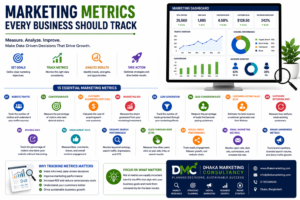
Essential Marketing Metrics Every Business Should Track
1. Website Traffic
Website traffic measures the number of visitors who visit your website.
This is often one of the first indicators of marketing effectiveness.
Why It Matters
Website traffic shows whether your marketing efforts are successfully attracting potential customers.
Key Traffic Sources
- Organic Search
- Direct Traffic
- Social Media
- Referral Traffic
- Paid Advertising
Tools
- Google Analytics
- Google Search Console
Businesses should monitor both traffic volume and traffic quality.
2. Conversion Rate
Conversion rate measures the percentage of visitors who complete a desired action.
Examples include:
- Filling out a contact form
- Subscribing to a newsletter
- Downloading a report
- Making a purchase
Formula
Conversion Rate = (Conversions ÷ Total Visitors) × 100
Why It Matters
A high conversion rate indicates that marketing efforts are effectively turning visitors into leads or customers.
3. Customer Acquisition Cost (CAC)
Customer Acquisition Cost measures how much it costs to acquire a new customer.
Formula
CAC = Total Marketing Cost ÷ Number of New Customers
Why It Matters
Understanding acquisition costs helps businesses evaluate marketing efficiency and profitability.
A lower CAC often indicates more effective marketing performance.
4. Marketing Return on Investment (Marketing ROI)
Marketing ROI evaluates the financial return generated by marketing activities.
Formula
Marketing ROI = ((Revenue – Marketing Cost) ÷ Marketing Cost) × 100
Why It Matters
ROI helps businesses determine whether marketing campaigns are generating profitable results.
Organizations should prioritize marketing activities that deliver the highest ROI.
5. Lead Generation
Lead generation metrics track the number of potential customers entering the sales pipeline.
Examples
- Contact Form Submissions
- Phone Calls
- Email Inquiries
- Consultation Requests
- Newsletter Sign-Ups
Why It Matters
Leads represent future sales opportunities and indicate marketing effectiveness.
6. Lead Conversion Rate
Generating leads is important, but converting those leads into customers is even more critical.
Formula
Lead Conversion Rate = (Customers ÷ Leads) × 100
Why It Matters
This metric measures the quality of leads and the effectiveness of sales and marketing efforts.
7. Customer Lifetime Value (CLV)
Customer Lifetime Value estimates the total revenue a customer generates throughout their relationship with a business.
Why It Matters
Businesses should focus on increasing long-term customer value rather than pursuing short-term sales alone.
A higher CLV often indicates strong customer satisfaction and loyalty.
8. Customer Retention Rate
Customer retention measures how successfully a business keeps existing customers.
Why It Matters
Retaining customers is generally less expensive than acquiring new ones.
Strong retention rates contribute to sustainable growth and profitability.
Benefits of High Retention
- Increased revenue
- Lower marketing costs
- Stronger customer loyalty
- Improved brand reputation
9. Bounce Rate
Bounce rate measures the percentage of visitors who leave a website without interacting further.
Why It Matters
A high bounce rate may indicate:
- Poor user experience
- Irrelevant content
- Slow page loading
- Weak call-to-action
Improving website quality often helps reduce bounce rates.
10. Engagement Rate
Engagement rate measures how users interact with content.
Examples
- Comments
- Shares
- Likes
- Clicks
- Time on Page
Why It Matters
Higher engagement typically indicates stronger audience interest and content relevance.
11. Organic Search Performance
Organic search metrics evaluate website visibility on search engines such as Google.
Key Indicators
- Organic Traffic
- Keyword Rankings
- Search Impressions
- Click-Through Rate (CTR)
Why It Matters
Strong organic performance generates sustainable traffic without ongoing advertising expenses.
12. Click-Through Rate (CTR)
CTR measures how often users click on a link after seeing it.
Formula
CTR = (Clicks ÷ Impressions) × 100
Why It Matters
CTR reflects the effectiveness of:
- Advertisements
- Email campaigns
- Search results
- Social media posts
Higher CTR often indicates more compelling marketing messages.
13. Social Media Performance Metrics
Social media platforms provide valuable performance data.
Important Metrics
- Reach
- Engagement
- Followers
- Shares
- Website Clicks
Why It Matters
These metrics help businesses understand audience engagement and content effectiveness.
14. Email Marketing Metrics
Email marketing remains one of the most effective digital marketing channels.
Key Metrics
- Open Rate
- Click Rate
- Conversion Rate
- Unsubscribe Rate
Why It Matters
Email metrics help businesses optimize communication and improve customer engagement.
15. Brand Awareness Metrics
Brand awareness reflects how familiar customers are with a business and its offerings.
Indicators
- Website Traffic Growth
- Social Media Mentions
- Branded Search Volume
- Direct Traffic
Why It Matters
Strong brand awareness often leads to higher trust, customer loyalty and market share.
Common Mistakes When Tracking Marketing Metrics
Tracking Too Many Metrics
Businesses should focus on metrics that directly support their objectives.
Ignoring Data Quality
Accurate data collection is essential for meaningful analysis.
Focusing Only on Vanity Metrics
Metrics such as likes and followers may look impressive but may not directly contribute to business growth.
Not Taking Action
Metrics provide value only when businesses use insights to improve performance.
How Dhaka Marketing Consultancy Helps Businesses Measure Marketing Success
At Dhaka Marketing Consultancy, we help organizations develop data-driven marketing systems that improve performance and support sustainable growth.
Our services include:
- Marketing Performance Analysis
- Market Research
- Customer Behavior Analysis
- Marketing ROI Evaluation
- Website Analytics Assessment
- Lead Generation Strategy
- Digital Marketing Support
- Business Growth Consulting
We help businesses identify meaningful metrics and transform marketing data into actionable business insights.
Conclusion
Marketing metrics are essential tools for measuring success, improving performance and achieving sustainable business growth. By tracking key indicators such as website traffic, conversion rates, customer acquisition costs, ROI, customer retention and engagement levels, businesses can make informed decisions and continuously optimize their marketing efforts.
In an increasingly data-driven world, organizations that monitor and analyze the right marketing metrics gain a significant competitive advantage. Rather than relying on assumptions, successful businesses use measurable insights to guide their strategies, strengthen customer relationships and maximize profitability.
Dhaka Marketing Consultancy supports businesses in building effective marketing measurement systems that transform data into growth opportunities and long-term success.