Introduction
In today’s highly competitive business environment, generating leads is only the first step toward success. Many businesses invest significant resources in marketing campaigns, social media advertising, and lead generation strategies but fail to convert those leads into paying customers. This is where Sales Funnel Optimization becomes essential.
A well-optimized sales funnel helps businesses guide potential customers through every stage of the buying journey—from awareness to purchase—while improving conversion rates, customer satisfaction and revenue growth.
At Dhaka Marketing Consultancy (DMC), we believe that effective sales funnel optimization is one of the most powerful strategies for sustainable business growth. This article explores the concept of sales funnels, their importance, key stages, and practical strategies for turning leads into loyal customers.
What Is a Sales Funnel?
A sales funnel is a structured process that represents the journey potential customers take before making a purchase decision.
The funnel is called a “funnel” because many people enter at the top but only a smaller percentage become customers at the bottom.
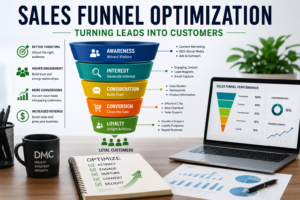
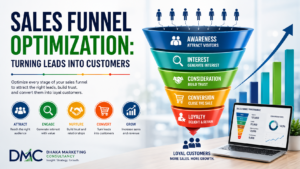
A typical sales funnel consists of four major stages:
- Awareness
- Interest
- Consideration
- Conversion
Businesses that effectively manage these stages can significantly improve their sales performance.
Why Sales Funnel Optimization Matters
Many organizations focus heavily on generating leads but overlook the importance of converting those leads.
An optimized sales funnel helps businesses:
- Increase conversion rates
- Improve customer engagement
- Reduce customer acquisition costs
- Shorten the sales cycle
- Enhance customer experience
- Increase revenue and profitability
- Improve marketing ROI
Without optimization, valuable leads may leave the funnel before completing a purchase.
Understanding the Stages of a Sales Funnel
1. Awareness Stage
This is the first interaction potential customers have with your business.
At this stage, prospects become aware of your brand through:
- Search engines
- Social media
- Blog articles
- Online advertising
- Referrals
- Industry events
Optimization Tips
- Create high-quality content
- Improve SEO performance
- Use targeted advertising
- Maintain an active social media presence
- Develop educational resources
The goal is to attract the right audience and build brand visibility.
2. Interest Stage
Once prospects discover your business, they begin learning more about your products or services.
They may:
- Visit your website
- Read blog posts
- Download resources
- Watch videos
- Follow social media accounts
Optimization Tips
- Provide valuable information
- Use engaging content
- Highlight customer benefits
- Offer free consultations
- Create compelling landing pages
The objective is to build trust and maintain engagement.
3. Consideration Stage
At this stage, potential customers compare alternatives and evaluate solutions.
They may ask questions such as:
- Why should I choose this company?
- What makes this solution different?
- Is it worth the investment?
Optimization Tips
- Showcase case studies
- Present testimonials
- Share success stories
- Provide detailed service information
- Offer personalized consultations
Trust-building becomes critical during this phase.
4. Conversion Stage
This is where prospects become paying customers.
A strong conversion strategy helps remove barriers and encourages action.
Optimization Tips
- Simplify the buying process
- Provide clear calls-to-action
- Offer limited-time incentives
- Ensure fast response times
- Reduce unnecessary form fields
A smooth and professional experience can significantly improve conversion rates.
Common Sales Funnel Problems
Many businesses experience funnel leaks that reduce conversion performance.
Common issues include:
Poor Lead Quality
Generating large numbers of irrelevant leads wastes resources and reduces efficiency.
Weak Follow-Up
Many businesses lose opportunities because they fail to follow up consistently.
Complicated User Experience
Complex websites, lengthy forms, and confusing navigation can discourage prospects.
Lack of Trust Signals
Without testimonials, reviews, and case studies, prospects may hesitate to purchase.
Inconsistent Messaging
Mixed marketing messages create confusion and reduce confidence.
Identifying these issues is the first step toward optimization.
Strategies for Sales Funnel Optimization
Improve Lead Qualification
Not all leads are equal.
Businesses should identify prospects most likely to purchase by evaluating:
- Industry
- Company size
- Budget
- Buying intent
- Decision-making authority
Qualified leads typically convert at much higher rates.
Create High-Converting Landing Pages
Landing pages play a crucial role in sales funnel performance.
Effective landing pages include:
- Clear headlines
- Strong value propositions
- Simple forms
- Customer testimonials
- Strong call-to-action buttons
Every element should encourage visitors to take the next step.
Use Marketing Automation
Automation improves efficiency and consistency.
Examples include:
- Automated email sequences
- Lead nurturing campaigns
- Follow-up reminders
- Customer segmentation
Automation helps businesses maintain engagement throughout the funnel.
Personalize Customer Interactions
Modern consumers expect personalized experiences.
Businesses can personalize by:
- Using customer names
- Recommending relevant services
- Delivering customized content
- Segmenting audiences
Personalization increases trust and engagement.
Strengthen Follow-Up Processes
Research consistently shows that many sales occur after multiple follow-up interactions.
Best practices include:
- Responding quickly to inquiries
- Scheduling follow-up calls
- Sending personalized emails
- Providing additional resources
Persistence often leads to higher conversion rates.
The Role of Content in Funnel Optimization
Content marketing supports every stage of the sales funnel.
Top of Funnel Content
- Blog posts
- Educational videos
- Social media content
Middle of Funnel Content
- Case studies
- Webinars
- Industry reports
Bottom of Funnel Content
- Testimonials
- Product demonstrations
- Consultation offers
Relevant content helps move prospects through the funnel effectively.
Key Metrics to Monitor
Sales funnel optimization requires continuous measurement.
Important metrics include:
Lead Conversion Rate
Percentage of leads that become customers.
Cost Per Lead (CPL)
Cost of acquiring each lead.
Customer Acquisition Cost (CAC)
Total cost of acquiring a new customer.
Sales Cycle Length
Time required to convert a lead into a customer.
Funnel Drop-Off Rate
Percentage of prospects leaving the funnel at each stage.
Return on Investment (ROI)
Measures profitability of marketing and sales activities.
Tracking these metrics helps identify opportunities for improvement.
How Dhaka Marketing Consultancy Helps Businesses Optimize Sales Funnels
At Dhaka Marketing Consultancy, we help businesses build and optimize effective sales funnels through:
- Marketing planning
- Market research
- Customer behavior analysis
- Lead generation strategies
- Digital marketing support
- Conversion optimization
- Competitor analysis
- Business growth consulting
Our data-driven approach ensures that businesses attract the right audience, nurture qualified leads and convert prospects into long-term customers.
Conclusion
Generating leads is important but converting those leads into paying customers is what ultimately drives business growth. A well-optimized sales funnel creates a structured path that guides prospects from awareness to conversion while improving customer experience and maximizing revenue.
Businesses that continuously analyze and improve their sales funnels can achieve higher conversion rates, stronger customer relationships and sustainable long-term success.
For organizations seeking measurable growth, sales funnel optimization is no longer optional—it is a critical component of modern marketing strategy.
Dhaka Marketing Consultancy (DMC) helps businesses develop effective marketing systems, optimize customer journeys and transform leads into loyal customers through research-driven marketing solutions and strategic business support.