
Introduction
Emerging markets have become some of the most attractive destinations for business growth and expansion. Countries across Asia, Africa, Latin America and parts of Eastern Europe continue to experience rapid economic development, increasing consumer purchasing power, urbanization and digital transformation. These factors create significant opportunities for businesses seeking sustainable growth beyond saturated markets.
However, expanding into emerging markets requires more than simply entering a new geographic location. Businesses must understand local customer behavior, cultural differences, economic conditions, regulatory environments and competitive landscapes. Organizations that approach expansion strategically are more likely to achieve long-term success while minimizing risks.
This article explores the importance of emerging markets, key expansion strategies, challenges businesses may face and practical approaches for achieving sustainable growth in these dynamic environments.
Understanding Emerging Markets
Emerging markets are economies experiencing rapid industrialization, economic growth and increasing integration into the global economy.
Common characteristics include:
- Growing middle-class populations
- Rising consumer spending
- Expanding digital adoption
- Increasing urbanization
- Developing infrastructure
- Improving business environments
Examples of emerging markets include:
- Bangladesh
- India
- Vietnam
- Indonesia
- Philippines
- Nigeria
- Kenya
- Brazil
- Mexico
These markets often offer substantial growth opportunities for businesses willing to adapt their strategies to local conditions.
Why Emerging Markets Matter
Expanding Customer Bases
Emerging economies often have large and growing populations with increasing purchasing power.
Untapped Market Opportunities
Many industries remain underdeveloped, creating opportunities for new products and services.
Rapid Economic Growth
Emerging markets frequently experience higher growth rates compared to mature economies.
Digital Transformation
The widespread adoption of smartphones and internet access creates new opportunities for digital marketing and e-commerce.
Diversification Benefits
Expanding into multiple markets reduces dependence on a single economy and spreads business risk.
Key Challenges of Entering Emerging Markets
Before expansion, businesses should understand potential challenges.
Cultural Differences
Consumer preferences, communication styles and purchasing behaviors often vary significantly across markets.
Regulatory Complexity
Different countries may have unique legal, tax, licensing and compliance requirements.
Infrastructure Limitations
Transportation, logistics, and technological infrastructure may vary significantly.
Competitive Pressure
Local businesses often possess strong market knowledge and established customer relationships.
Economic Uncertainty
Currency fluctuations and economic instability can impact business performance.
Despite these challenges, strategic planning can significantly improve the likelihood of success.
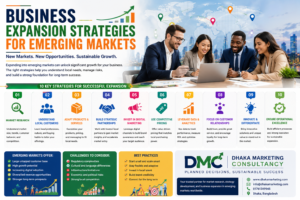
Effective Business Expansion Strategies for Emerging Markets
1. Conduct Comprehensive Market Research
Market research is the foundation of successful expansion.
Businesses should evaluate:
- Market size
- Customer needs
- Consumer behavior
- Industry trends
- Competitor activities
- Pricing expectations
Research helps organizations identify opportunities and avoid costly mistakes.
Key Questions to Answer
- Who are the target customers?
- What problems need solving?
- What products are currently available?
- What competitive advantages can be leveraged?
Reliable research supports informed decision-making.
2. Understand Local Consumer Behavior
Customer preferences vary across markets.
Businesses should analyze:
- Buying habits
- Cultural influences
- Brand perceptions
- Purchasing power
- Digital behavior
For example, consumers in emerging markets may prioritize affordability, convenience or local relevance more than premium features.
Understanding customer behavior improves product-market fit and marketing effectiveness.
3. Adapt Products and Services
A successful product in one market may require modification in another.
Localization may involve:
- Product features
- Packaging
- Language
- Pricing
- Customer support
Businesses that tailor offerings to local needs often achieve higher adoption rates and stronger customer satisfaction.
4. Develop a Strong Market Entry Strategy
Several market entry approaches are available.
Direct Exporting
Selling products directly into the target market.
Local Partnerships
Collaborating with local distributors, agents or businesses.
Joint Ventures
Sharing resources and expertise with local partners.
Franchising
Expanding through licensed business operators.
Establishing Local Operations
Opening offices, branches, or subsidiaries.
The best approach depends on business objectives, resources and market conditions.
5. Build Strategic Local Partnerships
Local partnerships can significantly improve market entry success.
Benefits include:
- Local market knowledge
- Established networks
- Faster market access
- Reduced operational risks
- Regulatory guidance
Potential partners include:
- Distributors
- Retailers
- Industry associations
- Marketing agencies
- Technology providers
Strong partnerships often accelerate business growth.
6. Invest in Digital Marketing
Digital marketing has become one of the most effective expansion tools in emerging markets.
Popular digital channels include:
- Google Search
- YouTube
Benefits include:
- Cost-effective customer acquisition
- Precise audience targeting
- Performance measurement
- Increased brand awareness
Digital marketing enables businesses to reach customers efficiently and scale rapidly.
7. Focus on Brand Building
Brand trust is critical when entering new markets.
Businesses should prioritize:
- Consistent messaging
- Professional online presence
- Customer testimonials
- Educational content
- Strong customer service
A trusted brand often gains market acceptance faster than unknown competitors.
8. Implement Competitive Pricing Strategies
Pricing plays a significant role in emerging markets.
Businesses should consider:
- Local purchasing power
- Competitor pricing
- Value perception
- Distribution costs
Affordable pricing combined with strong value propositions often drives market adoption.
However, competing solely on price may reduce profitability.
The goal should be value-based pricing rather than simply offering the lowest price.
9. Leverage Data and Analytics
Data-driven decision-making improves expansion outcomes.
Businesses should monitor:
- Website traffic
- Lead generation
- Conversion rates
- Customer acquisition costs
- Customer satisfaction
- Market trends
Analytics provide valuable insights that support ongoing optimization.
10. Build Long-Term Customer Relationships
Sustainable growth depends on customer retention as much as acquisition.
Relationship-building strategies include:
- Excellent customer service
- Personalized communication
- Loyalty programs
- Customer feedback systems
- Community engagement
Strong customer relationships often generate repeat business and referrals.
The Role of Innovation in Emerging Market Expansion
Innovation can create competitive advantages in developing markets.
Examples include:
Digital Solutions
Mobile applications and online platforms improve accessibility and convenience.
Flexible Business Models
Subscription services, installment payments, and digital payments may increase customer adoption.
Technology Integration
Artificial Intelligence, automation, and data analytics enhance efficiency and customer experiences.
Businesses that innovate often outperform competitors in rapidly evolving markets.
Measuring Expansion Success
Businesses should establish clear performance metrics before entering a new market.
Important metrics include:
Revenue Growth
Measures overall financial performance.
Market Share
Indicates competitive positioning.
Customer Acquisition
Tracks new customer growth.
Customer Retention
Measures long-term customer loyalty.
Brand Awareness
Evaluates market recognition and visibility.
Marketing ROI
Assesses the effectiveness of marketing investments.
Regular monitoring helps businesses adjust strategies and improve results.
Sustainable Growth in Emerging Markets
Successful expansion is not simply about entering a new market; it is about building a sustainable presence.
Organizations should focus on:
- Understanding local needs
- Creating customer value
- Building strong relationships
- Maintaining operational excellence
- Continuously adapting to change
Businesses that prioritize long-term value creation often achieve stronger and more sustainable growth.
How Dhaka Marketing Consultancy Supports Market Expansion
At Dhaka Marketing Consultancy, we help businesses identify opportunities and develop effective expansion strategies for emerging markets.
Our services include:
- Market Research
- Customer Behavior Analysis
- Competitor Analysis
- Marketing Strategy Development
- Brand Positioning
- Business Growth Consulting
- Digital Marketing Support
- Market Entry Planning
We provide data-driven insights that help businesses reduce risks, identify opportunities and achieve sustainable growth in new markets.
Conclusion
Emerging markets offer tremendous opportunities for business growth, customer acquisition and long-term profitability. However, successful expansion requires careful planning, market research, customer understanding, and strategic execution.
Businesses that adapt their products, build local partnerships, invest in digital marketing and focus on customer relationships are better positioned to thrive in these dynamic environments. Rather than viewing expansion as a short-term opportunity, organizations should approach emerging markets with a long-term perspective focused on sustainable value creation.
With the right strategy, emerging markets can become powerful engines of business growth and competitive advantage in the global marketplace.
Dhaka Marketing Consultancy helps businesses navigate emerging market opportunities through professional research, strategic planning and marketing solutions designed to support sustainable business expansion and long-term success.